2026: Does the Hydraulic Pallet Truck Still Have a Positive Role in the AI World?
As we step into 2026, the wave of artificial intelligence (AI) continues to reshape the landscape of smart logistics and manufacturing. Automated Guided Vehicles (AGVs), Autonomous Mobile Robots (AMRs), and AI-driven warehouse management systems (WMS) have become the new norm, promising unprecedented efficiency and precision. In this era of rapid automation, a question naturally arises:
Does the humble hydraulic pallet truck, a staple in material handling for decades, still hold its ground? Or is it destined to be replaced by more advanced AI-powered equipment?
The answer, as we will explore, is not a simple yes or no—but a testament to the enduring value of practical, adaptable tools that complement, rather than compete with, cutting-edge technology.
The Current State of the Hydraulic Pallet Truck Market: Resilience Amid Automation
First, let’s take a look at the hard data. According to market research, the Chinese pallet truck market has maintained steady growth from 2021 to 2025, with the market size increasing from 3.86 billion yuan to 5.92 billion yuan, representing a compound annual growth rate of 11.3%. While it’s true that fully automated equipment like AGVs and AMRs are gaining traction, hydraulic pallet trucks—especially semi-electric and intelligent variants—are not fading away.
In 2025, manual pallet trucks still accounted for 68.4% of the market, semi-electric models rose to 25.1%, and fully electric ones, which are increasingly integrated with smart technologies, reached a 6.5% share . This data clearly indicates that hydraulic pallet trucks remain an indispensable part of the material handling ecosystem, even as AI transforms the industry.
The resilience of pallet trucks stems from their unique advantages that AI-powered robots cannot easily replicate. For one, they are cost-effective. Small and medium-sized enterprises (SMEs), which make up the majority of businesses worldwide, often cannot afford the high upfront investment and maintenance costs of AGV fleets.
A manual or semi-electric hydraulic pallet truck, by contrast, offers a low-cost, high-return solution for light to medium-duty tasks. For another, they are highly adaptable. Unlike AGVs that require pre-defined paths (such as magnetic strips or laser navigation beacons) or AMRs that may struggle in complex, cluttered environments, hydraulic pallet trucks can operate in tight spaces, uneven terrain, and temporary work areas with minimal setup. This flexibility is crucial in industries like construction, small-scale manufacturing, and local logistics, where working conditions are often unpredictable.
Hydraulic Pallet Trucks and AI: A Synergistic Relationship, Not a Replacement
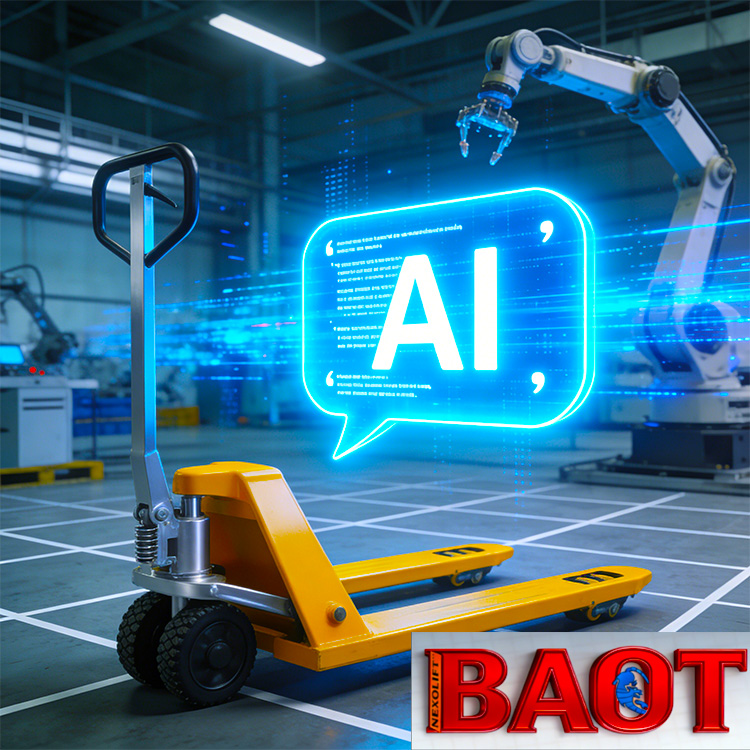
Far from being rendered obsolete by AI, hydraulic pallet trucks are evolving to work in tandem with intelligent systems, creating a more efficient and flexible material handling workflow. The key lies in understanding that AI and hydraulic pallet trucks serve different, yet complementary, roles. AI excels at large-scale, repetitive tasks, real-time data analysis, and complex scheduling, while hydraulic pallet trucks excel at small-scale, on-demand, and adaptive material handling. Together, they form a “human-machine collaboration” model that leverages the strengths of both.
Complementing Large-Scale Automation in Smart Warehouses
In large smart warehouses, AI-driven systems like digital twin platform optimize overall operations by simulating workflows, dynamically adjusting storage strategies, and coordinating AGV fleets. However, even in these high-tech environments, hydraulic pallet trucks play a vital supporting role.
For example, during peak periods (such as the Double 11 shopping spree in China), when AGVs are operating at full capacity, hydraulic pallet trucks can handle sudden, small-batch tasks—such as moving a single pallet of urgent orders from the sorting area to the shipping dock—that would otherwise disrupt the automated workflow. In addition, AGVs often struggle with tasks that require frequent changes in direction or precision placement in narrow aisles. Hydraulic pallet trucks, operated by skilled workers, can complete these tasks quickly and efficiently, filling the gaps in automated systems.
Integrating AI Technologies to Enhance Hydraulic Pallet Truck Performance
Another way hydraulic pallet trucks are adapting to the AI world is through the integration of intelligent technologies. Manufacturers are increasingly equipping hydraulic pallet trucks with sensors, UWB positioning modules, and AI-powered remote diagnostic systems. These upgrades transform traditional hydraulic pallet trucks from simple mechanical tools into “smart nodes” in the logistics network, enabling them to communicate with AI management systems and contribute to data-driven decision-making.
Supporting Flexible Production in Specialized Industries
In specialized industries like pharmaceuticals, cold chain logistics, and new energy manufacturing, the combination of pallet trucks and AI is proving to be particularly effective. These industries often have strict requirements for product traceability, environmental control, and operational flexibility—needs that neither fully automated robots nor traditional manual tools can meet alone.
The Future of Hydraulic Pallet Trucks in 2026 and Beyond: Intelligence, Greenization, and Modularization
Looking ahead to 2026 and beyond, the role of hydraulic pallet trucks in the AI world will continue to evolve, driven by three key trends: intelligence, greenization, and modularization. As edge AI chip costs decline and technology becomes more, we can expect to see more hydraulic pallet trucks equipped with advanced features like autonomous navigation (for simple paths), voice control, and real-time data sharing with WMS and TMS (Transportation Management Systems). These intelligent upgrades will further enhance their integration with AI systems, making them an even more valuable part of the smart logistics ecosystem.
Greenization is another important trend. With the global focus on carbon neutrality, manufacturers are developing pallet trucks made from lightweight, recyclable materials (such as aluminum alloys) and equipped with energy-efficient hydraulic systems and electric motors.
These green hydraulic pallet trucks not only reduce carbon emissions but also align with the ESG (Environmental, Social, and Governance) goals that many enterprises are now prioritizing. AI can play a role here by optimizing energy usage. By adopting a modular design, manufacturers can offer customizable solutions that meet the specific needs of different industries.
Conclusion: The Indispensable Role of Hydraulic Pallet Trucks in the AI Era
In 2026, the question is not whether hydraulic pallet trucks have a role in the AI world, but how they will adapt and thrive alongside intelligent technologies.
So, the next time you walk into a smart warehouse or a modern manufacturing plant, don’t be surprised to see AI-powered robots and hydraulic pallet trucks working side by side. Together, they are building a more efficient, flexible, and sustainable future for logistics—one pallet at a time.